
Taste over process
The best companies I've read about this year explicitly don't want the ritual anymore.

I’ve been looking at job descriptions lately at the kind of companies I actually pay attention to, and the best ones keep saying the same unusual thing: they don’t want you to prove your process anymore.
Not “we value efficiency.” Something more specific. A few years ago a wireframe existed because it was fast to make and the real product wasn’t. Now, I can build the real thing almost as fast as I used to fake one, so the fake one isn’t worth making anymore.
Ashby’s posting, written by their head of design, puts it as a qualification:
“Enough experience that your intuition can solve many usability problems without having to rely solely on data & metrics or conducting user research.”
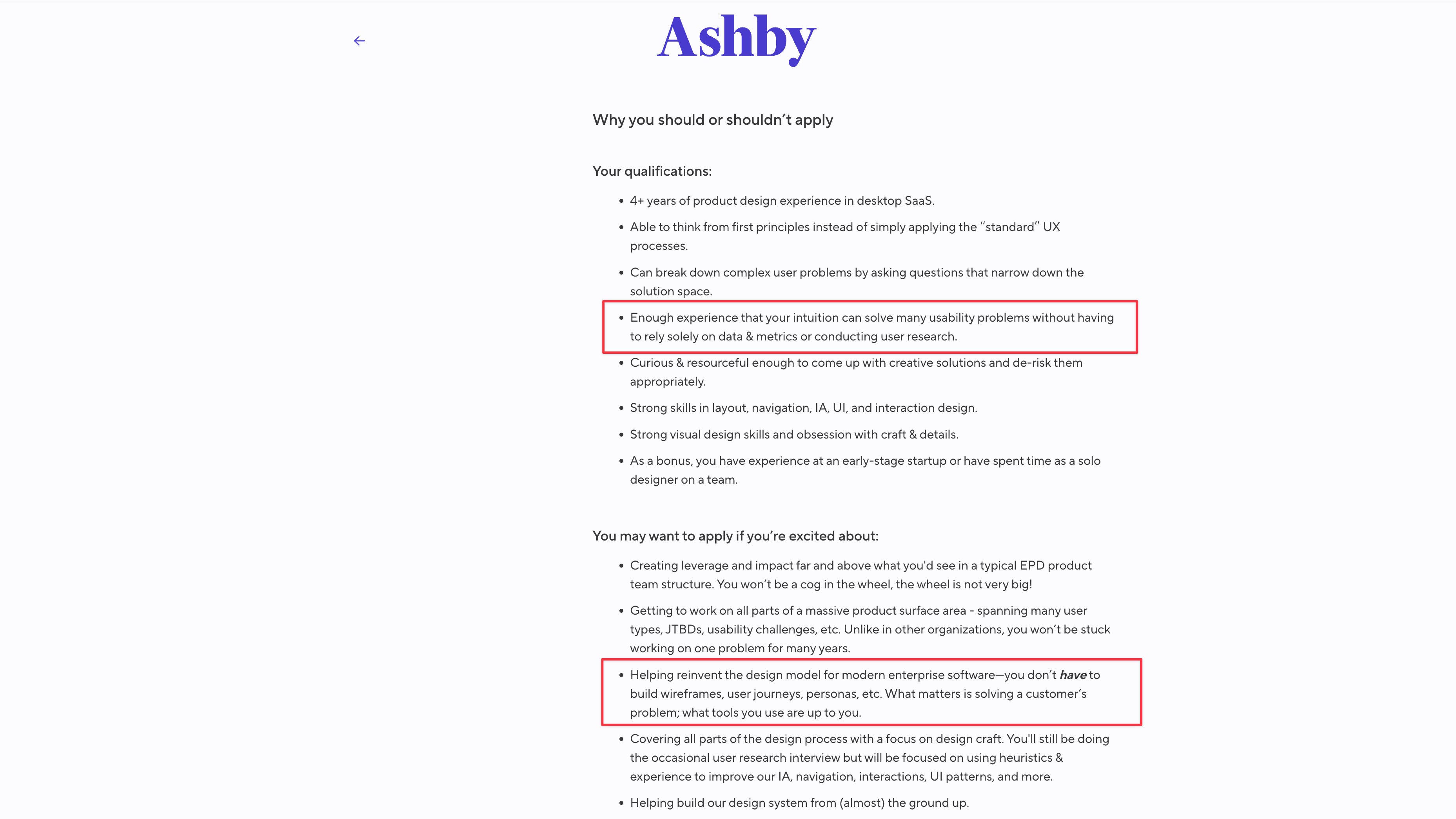
That’s not a company being sloppy about process. It’s a company that figured out process was never the point, it was just how you proved you had taste to someone who couldn’t see it directly. Once they can see it directly, they don’t need the proof.
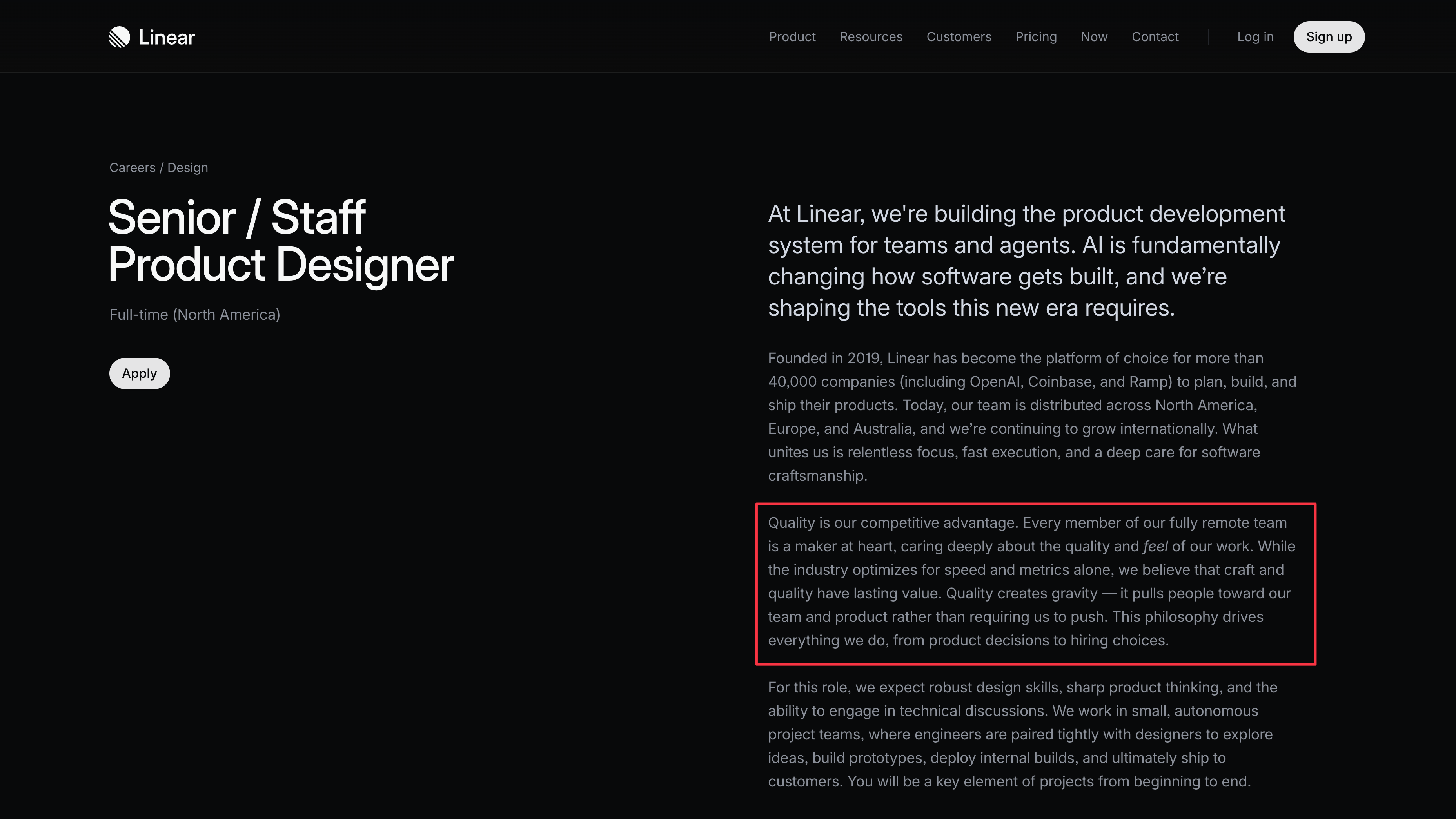
Linear says it differently, but it’s the same idea:
“Quality is our competitive advantage… While the industry optimizes for speed and metrics alone, we believe that craft and quality have lasting value. Quality creates gravity…”
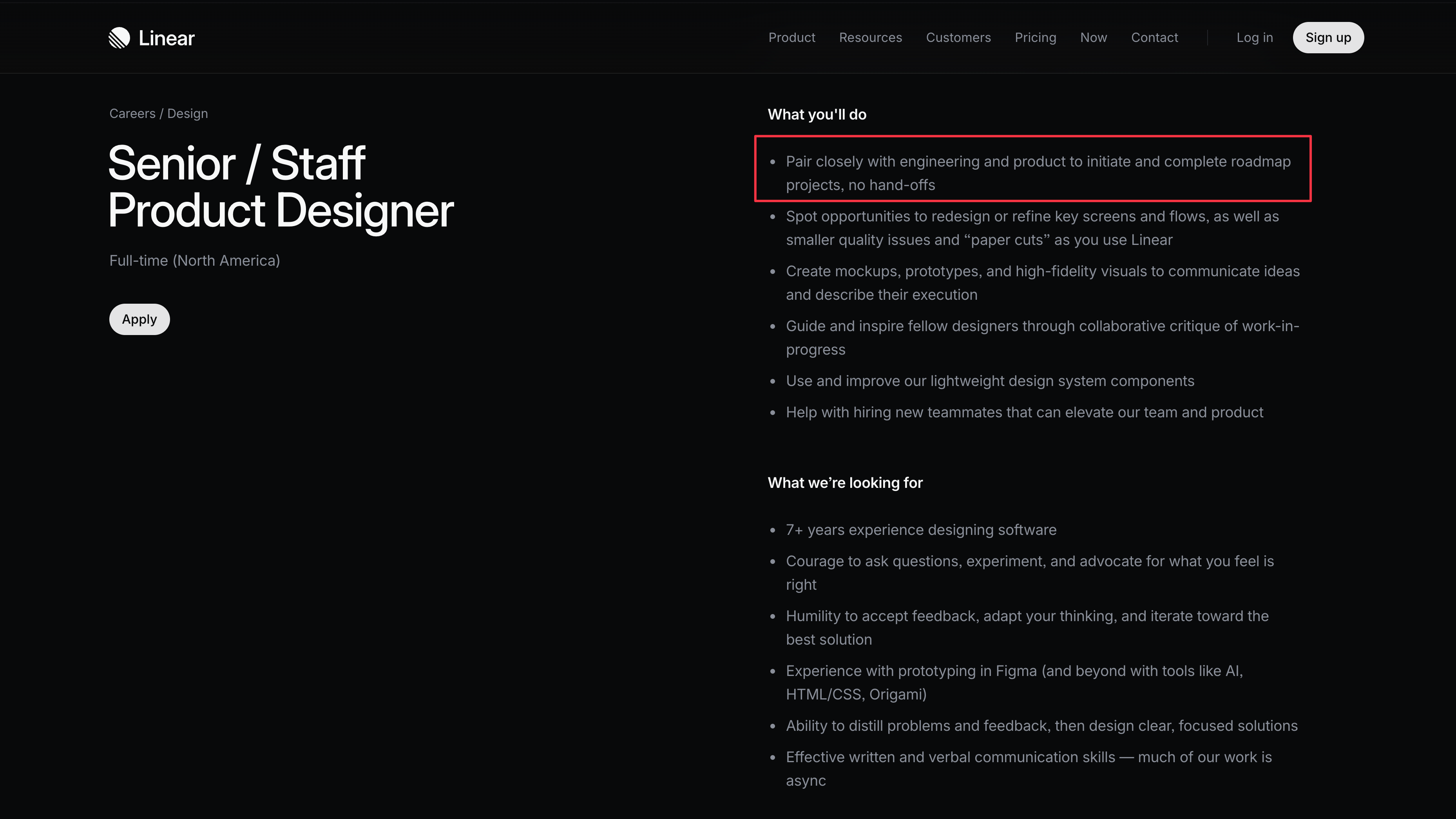
And then, in plain language:
“Pair closely with engineering and product to initiate and complete roadmap projects, no hand-offs”
I used to think process was the professional way to do this job. Research phase, then wireframes, then mocks, then a handoff to engineering, each stage justifying the next one, the paper trail proving the work was careful.
I was good at the paper trail and for a long time I thought that was the actual skill.
It wasn’t. The paper trail was a way of proving taste to people who couldn’t otherwise see it. Wireframes exist because “trust me, this will feel right” isn’t something you can hand to a stranger and expect them to believe. Research decks exist because raw intuition doesn’t come with a citation. The ritual was scaffolding for trust, not the work itself.
Take the scaffolding away and what’s left is just: was your instinct right or wrong. Companies like Ashby and Linear are both saying, out loud, in a job posting, that they’d rather find out directly.
That’s a harder thing to be hired for, not an easier one. A process gives you partial credit – you can point to the research, the wireframes, the documented rationale, even when the outcome is mediocre. Taste doesn’t give you partial credit. Either the thing feels right or it doesn’t, and everyone can tell immediately, including you.
I don’t think this makes the old way wrong. Plenty of real problems still need the research, still need the paper trail, still need a junior designer’s judgment checked before it ships.
But I noticed the companies I actually admire keep removing the scaffolding on purpose, and I don’t think that’s a coincidence, and I don’t think it’s only about speed either.
It’s a bet that taste, once you can verify it directly, is worth more than the process that used to stand in for it.
I’d take that bet. I’ve just never seen it written into a job description before.
– Mujtaba M
Sources:
Anthropic, Product Designer, Claude Code – “We'd rather get something in front of users and iterate than wait for perfection.”
Citizen, Product Design Engineer – “Someone who would rather build a prototype than create a presentation.”